
Coppercoat Antifouling On Test
Well, almost a year has passed since we slipped the boat and slapped on a coat of copper antifouling. So, it’s time we let you know how things are doing down there, under the water.
To recap: Before we built Mollymawk we used to own a GRP yacht, and a year or so before we sold her she was painted with Copperbot, the original copper-impregnated epoxy antifouling. This type of antifouling is said to be less damaging to the environment than any of the metal-leaching kinds, but it was a very new thing at that time and we knew that we were taking a gamble.
Happily, the gamble paid off; that copper paint was fantastic. The boat once spent three months in a French marina renown for its fouling, and while the other yachts all acquired lush gardens and pet eco-systems on their undersides, our boat stayed absolutely and perfectly clean!
 Unfortunately, that paint was also very expensive, and when we came to launch the new boat we simply couldn’t afford to give her the same treatment. So we mixed our own antifouling, using two kilograms of copper dust to one litre of epoxy (which is the legal, environmentally safe maximum).
That home-brewed copper-impregnated epoxy worked, after a fashion, but nowhere near so well as the real thing. Thus it was that, eight years on, we decided to make the necessary investment. By this time the founder of the Copperbot company had died, but his formula had been bought by the main sales agents, Aquarius Marine. Aquarius are now producing the same paint but under a slightly different name – Coppercoat – and thus it was that we came to be slapping on genuine Coppercoat antifouling.
Actually “slapping on” is not the right terminology for the long and elaborate process of painting a boat with Coppercoat. Other, more conventional antifoulings can be applied over pretty much any other muck – having bought the paint one simply opens the tin and starts daubing – but the application of Coppercoat is such a fine art that the manufacturers even supply an explanatory DVD. We watched it, and then we followed the instructions to the letter.
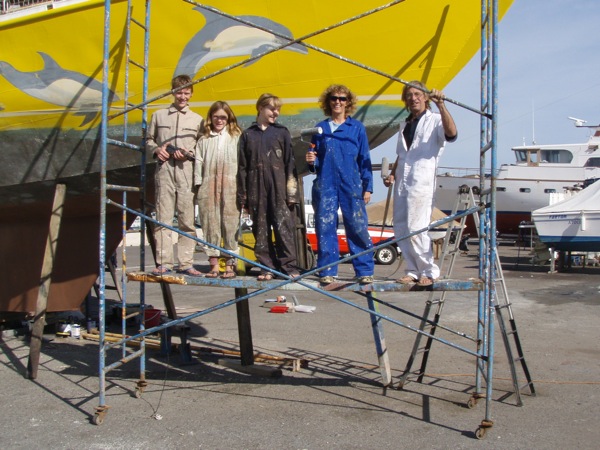

First we spent a week preparing the hull, removing every last vestige of barnacle shell from our previous coat of home-brewed copper antifouling. Then we mixed the epoxy and stirred in the appropriate quantity of copper powder, using an electric drill as a whisk. After that we applied the necessary coats, at the appropriate time intervals, four of us working at this task while the fifth member of the crew was permanently employed in stirring the paint. Then we waited, with one eye on the sky – because the new paint had to be kept absolutely dry for the requisite interval. Then, finally, just before Mollymawk went back in the water, we burnished the hull, thereby exposing the copper.
What a performance!
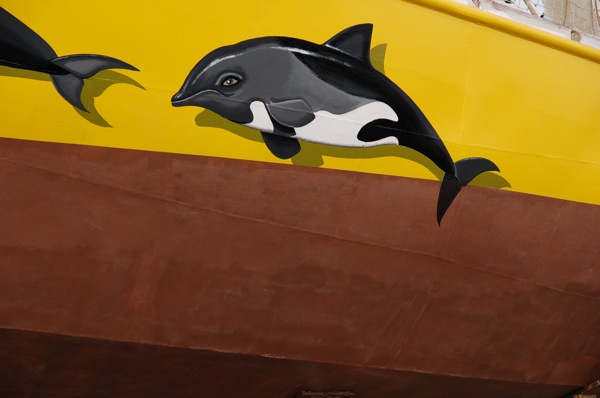
While we were working on the boat various other yotties came to watch. “Why are you going to all this trouble?” they wanted to know.
We explained that Coppercoat is (allegedly, at any rate) far less damaging to the environment than conventional antifoulings. It appears to have the approval of the UK Environment Agency, who applied it, ten years ago, to a 10m RIB. According to their spokesman: “It doesn’t harm the marine life but just stops adhesion of growth.”
Moreover, although it costs more than twice as much as conventional antifouls our efforts would pay for themselves in the long run. The usual paints leach toxins into the environment and so are gradually used up.
“If you’re still using that old-fashioned poison,” we said, “then you’ll have to slip your boat again in a year or two. But our copper bottom will last far longer. With any luck, we won’t have to slip again for another ten years!”
Indeed, the manufacturers call Coppercoat “10+ year anti-fouling”
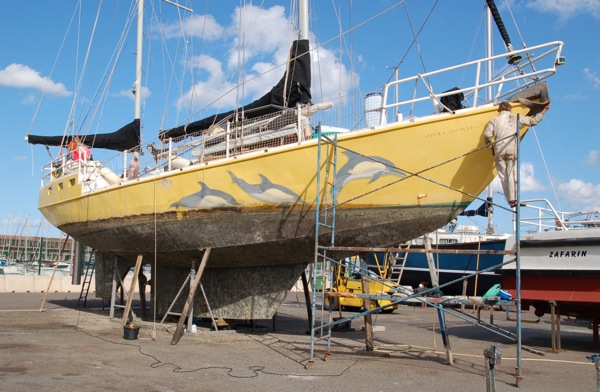

Copper-impregnated paint is coppery-pink when it goes on, but within two or three days of her launch Mollymawk’s antifouling had taken on a dark green hue – and so we knew that the metal had, indeed, been successfully exposed to the elements.
We sat back. It had been a gruelling fortnight, and the extra expense had been burdensome too, but we knew that it was all worthwhile.
Nine months later – well, to say that we were disappointed would be a grave understatement.
Our new Coppercoat antifouling is being tested alongside a strip of Hempel’s antifoul, a strip of our old home-brewed copper-epoxy paint, and a band of household emulsion paint which was saturated with hot chilli powder. These other paints (and a couple of combinations of these paints) were applied late last summer to our self-steering rudder.
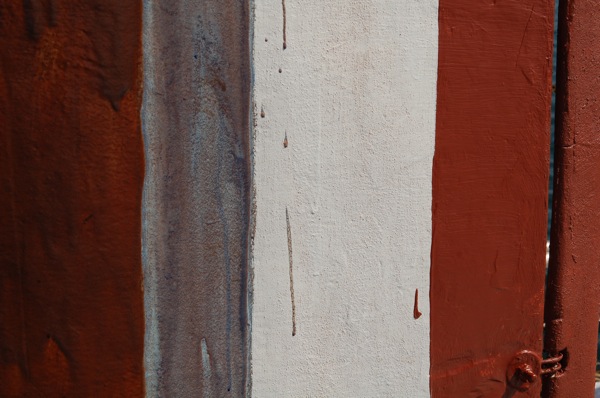 The first photo shows the rudder as it was when first painted, last September.
From left to right we have, firstly, our own copper-epoxy mix with a dash of chilli powder added. Then we have the same copper-epoxy on its own. In the middle of the rudder we have a broad band of white household paint saturated with chilli powder. Then we come to the Hempels antifouling, and finally to Hempels with a touch of chilli (on the trim tab).
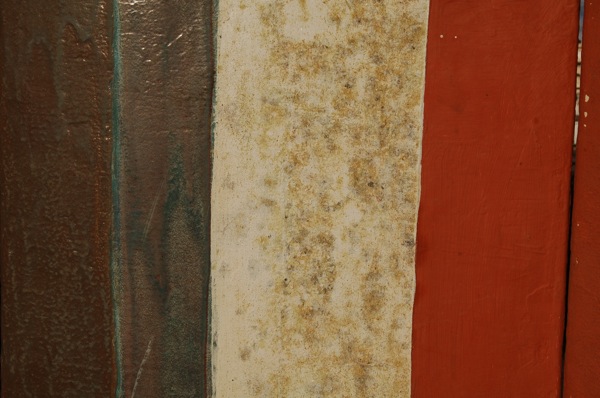 The second photo shows the rudder six weeks later, when the boat was out of the water. As you can see, the chilli-pepper paint is already becoming degraded.
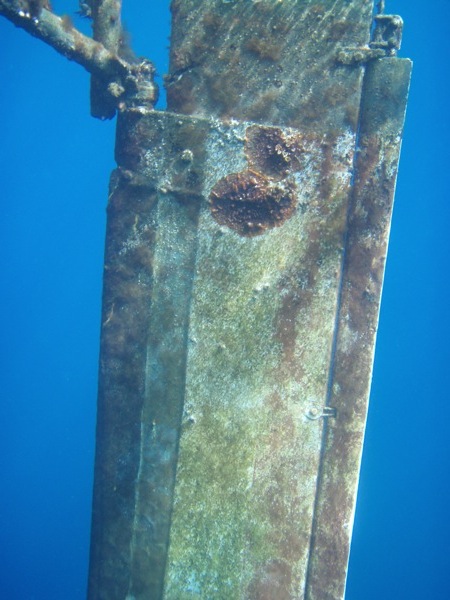 When we slipped the boat we applied the new Coppercoat not only to the hull but also to the upper part of the self-steering rudder, above the other paints, and to the frame which supports the rudder.
The third photo shows the results, eight months later.
At this stage the Hempels and the Hempels-plus-chilli seem to be performing best, but there is plenty of fouling even on those stripes. The household paint with the chilli pepper is now home to several barnacles and a weird red thing. Our home-made copper epoxy and the Coppercoat are both equally coated in slime and tufts of weed.
 The fourth photo shows the rudder nine months after the Coppercoat was applied (and a year after the other paints).
The household paint with the chilli pepper has clearly failed the test. What a pity that we didn’t think to include a stripe of unadulterated household paint, so that we could see whether the chilli had any effect at all.
Meanwhile, the Hempels antifoul is also faring rather badly. Its antifouling properties have been exhausted.
The weeds growing on the Coppercoat have become a little more luxuriant.
But the home-brewed copper-epoxy actually seems to have shed some of that slime, and both the plain stuff and the stripe with the chilli pepper are doing reasonably well. They are not doing as well as we would have hoped – certainly, they are not doing as well as the original Copperbot which we applied, all those years ago, to our GRP boat – but they are doing rather better than the competition.
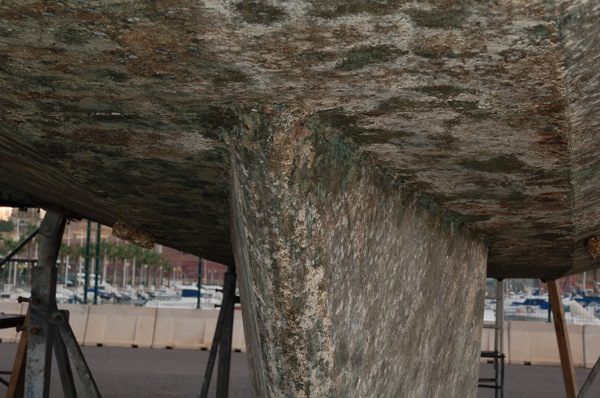
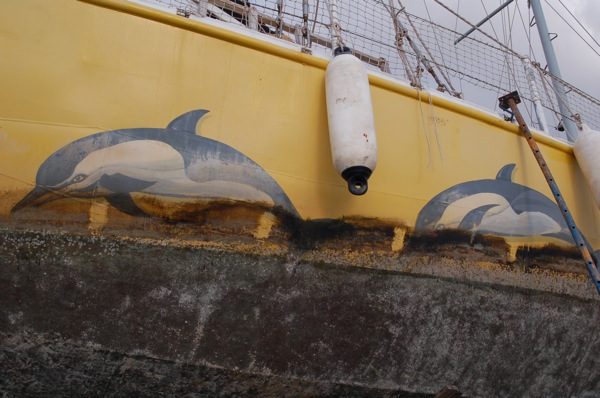
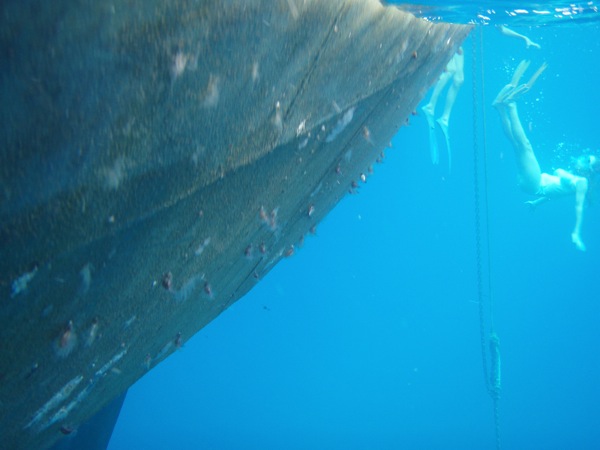
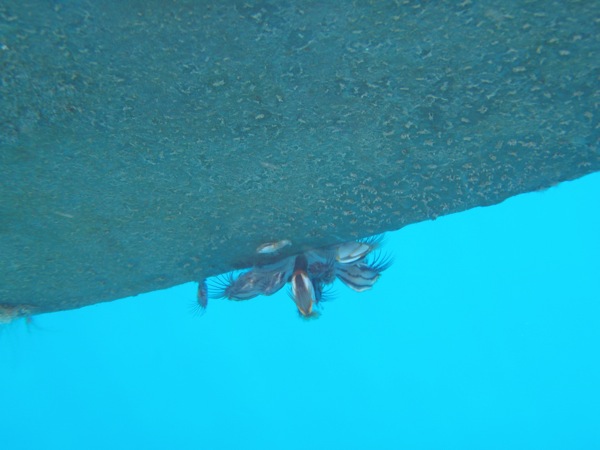
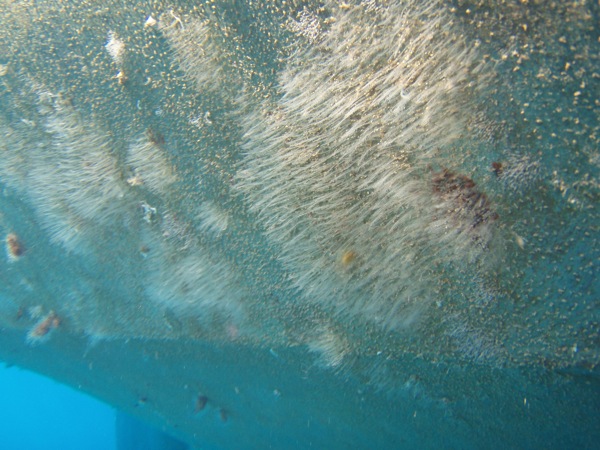
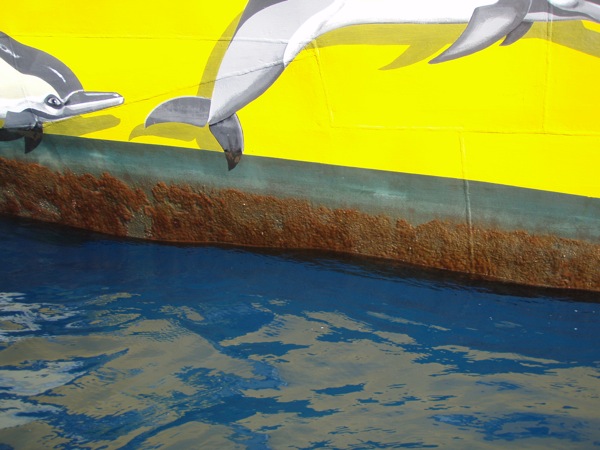
The following photographs show various other areas of the hull eight months after the Coppercoat was applied.
Note that the fouling, here in the Canaries, is very far from being the worst that we have ever seen. Indeed, it is nothing compared to the fouling in the Mediterranean.
In conclusion, the expensive Coppercoat paint is performing notably less well than our previous, cheap and cheerful home-brewed copper-epoxy antifouling!
So much for 10+ years! Our Coppercoat did not even serve its purpose for 10 months!
But why is this so? It works for some other people – it worked for us when we used it on our previous boat – so why do we now find ourselves having to dive on the hull every month and scrape the waterline on a weekly basis?
Before posting this report we sent it to the folks at Coppercoat, asking for their comments. In return we received a lengthy reply which includes the following especially pertinent remarks:
It would be standard practice (and advisable) to clean a Coppercoat treated boat once a season, but as you might expect, some people clean their boats more regularly than this while others do it less frequently.
We know of owners who rarely need to clean their hulls – and I heard from one owner who did not touch the bottom of his boat for five years! However, at the other end of the scale I know of a client in the Caribbean that dives under his boat and cleans the hull approximately three times a year.
To our way of thinking, if you have to dive on your boat and clean it three times a year, then the antifoul, by definition, is not working. We did not have to dive on our ultra-cheap home-brewed copper-epoxy and clean the boat until she had been in the water for three years.
While Coppercoat offers a strong degree of protection against most fouling in most locations for many years – it is not described as a “maintenance-free” product and periodic cleaning of the hull should be expected.
Please remember that unlike conventional anti-foul (that starts off at full strength and becomes weaker by the day), Coppercoat is actually quite a mild anti-foul when new. Coppercoat increases in potency as the months and years pass. This is because it takes some time for the epoxy to begin to break down and allow the formation and release of its powerful anti-fouling agent cuprous oxide. Consequently it is usual for Coppercoat to perform better in its second year and beyond, than it does in its first year. It is likely therefore that you will see a further improvement in the performance of the coating in the coming years.
The trouble is, we will not see an improvement of this kind unless we can keep the hull clean. Once the barnacles and the white stuff have settled removing them is very difficult, even with a metal scraper. They invariably leave a little mark behind, and new arrivals subsequently find it very easy to attach themselves to these unprotected areas.
I suspect that the performance of the Coppercoat will improve while the performance of all the others (ie. the Hempels, the home-brew, and the chilli) will deteriorate. Consequently when you update this report next year, and the year after (and so on), the performance and value given by the Coppercoat will be in stark contrast to the other coatings.
Well, we sincerely hope that this is true… but we have our doubts. [See our Apr 2012 update.]
 Coincidentally, a friend who painted his catamaran with Copperbot some ten years ago also had a very good experience of that product and has also just repainted the boat using Coppercoat. He is having much the same sort of experience as us, with quite large barnacles already appearing on his hulls after only one month afloat.
If you have used Copper-impregnated epoxy antifouling on your boat we would like to hear from you. Please use the comments box (below) or drop us a line using the contact form.
Besides telling us which particular brand of copper-epoxy antifouling you used and whether the paint worked for you, please let us know where your boat is moored, or where you have been cruising.
For our next antifouling test we hope to be able to review ePaint – a type which leaches hydrogen peroxide into the water. Whilst it isn’t reckoned to be long-lasting, this particular paint is said to be completely sound from an environmental point of view; and if we can find a paint which does no harm but which keeps our hull clean then we will have succeeded in our objective.
For our latest research and observations on this topic, please see The Search for an Effective and Environmentally-Safe Antifouling.
Thank you very much for taking the time and trouble to publish this very helpful review. Much appreciated. I think I’ll try your home-made solution, but using household gloss paint (or two part varnish/paint) and perhaps less that the 2kg/lt? Burnishing, sounds good, to expose the active ingredient! Thanks again.
Hi Allan, thanks for commenting.
The idea of using ordinary paint or two part varnish sounds interesting, but we’re not sure that it would work.
Firstly, it may not be durable enough. Epoxy, such as we used, is very hard. If you use something less durable it will obviously need redoing sooner.
Secondly, you might find that the copper doesn’t stay in suspension in the paint in the same way. When we did our test with chilli powder in ordinary paint, the chilli sank into the paint, away from the surface.
Thirdly, the epoxy electrically isolates each copper particle, protecting against electrolysis. The paint would be likely to be less viscous, and so would be less inclined to do this.
Why do you want to use paint/varnish rather than epoxy, anyway? Just to reduce the price? I can’t think of any other reasons not to use epoxy…
If you do use epoxy, note that the Coppercoat epoxy is a special “water-miscible” one. In theory, this means that the water can penetrate the epoxy and thus helps to expose the copper. In practice, however, our home-brew worked better despite using ordinary non-water-miscible epoxy.
A final note – if you do use less copper, your antifouling will be less effective and last less long. In the long run, you’ll probably find it’s more expensive. (But you mustn’t use more, because more is damaging to the environment, and is therefore illegal.)
Anyway, good luck with your home-brew – and please let us know how you get on!
Wondering, about applying actual sheet copper to the boat, yeah, like the paint, it’s expensive, but it should last 20 years or more! I do think no matter what is used, periodic cleaning is just part of the game!! Copper sulfate is what we use to keep the lake clean of algae and grasses, it does not harm the fish or turtles, etc!!
That’s what they used to do with the old sailing ships, and in fact we know a couple with an old wooden yacht who have the same system, and swear by it. (They sail high latitudes, and it also protects the wood from ice damage on the waterline.)
On a wooden boat it’s easy enough to nail the copper onto the boat (copper nails of course). But how would you attach it to a steel or fibreglass boat?
Yes I agree very interesting.
But how do you mix 2kg powder into 1 ltr of epoxy?
That would be so thick it would be applied by a putty knife!
I took the remnants of copper coat of my hull 4 years ago and started using yotun the high copper one. And that’s 350 Australia dollar for 10 ltr and 3 coats is good for 2 years.
That’s good enough for that price, three days out of the water and splash back in. All up 1200 Australia dollars.
The key is that copper is very heavy, so 2kg isn’t actually very much in volume. ‘Genuine’ Coppercoat uses 2kg copper per litre epoxy, and so did we when we made our homebrew version. It’s not thick at all; actually quite runny.
Hi guys.
I went a bit further with the copper and had great success. Eg i copper plated the bottom plus mixed copper powder in with reason for through hull fittings and a cast iron keel left the prop alone nothing stick’s to a prop.
I am in the habit off jumping in after anchoring to check my hook, So when in the water a qwik dust of and check of the bottom is in order 10/15 minutes, Anything on it comes right of,(cut off jeans are the rag of choice. I understand its good for 40 years, Cost about $7,000 took 7 weeks to complete.
I am working on a how to manual and slide show for an e book right now. E mail me and i will send you a photo, Royal star is a Yokahama Yawl 1959 sailed 5/6,000 miles.No prob presently in New Orleans USA. The Canaries you must be heading to St Lucia don that crossing 7 times only once single handed.
Sorry for not replying sooner.
You say you “copper plated the bottom” – how? Did you attach copper plates to the entire surface, as they used to do on the old sailing ships? If so, how did you attach them? If your boat is wooden you could nail them, but for a steel boat it would be difficult to attach them.
Hello,
very interesting. Reading this it seems that they have changed the formulation. There is a new product launched, which is also a hard antifouling based on pure copper but needs only 1 coating and is easy to apply. http://www.verometalmarine.com We like the idea to have only 1 coating for many years, thus not polluting the environment with all that antifouling paints. Up to now only good experience about it. So we will try it.
Thanks for pointing out that product. Interestingly, they use polyester rather than epoxy. Since polyester is harder and less flexible, it is more liable to crack or chip, so it would seem likely to last less long.
Let us know how well it works for you!
Hi there,
I am very interested in your comments on Coppercoat – not least because we were at the London boat show yesterday and visited them there. We are leaving this coming summer to cruise on out yacht and like you,dont really want the huge expense of coppercoat but similarly would like a long term coating before we leave.
One option I would like to try is the homemade version you mixed and used, and wonder if you would let me know the ingredients, type of copper powder etc.
Though I’m sure its still quite costly this way, it must be cheaper that the £1750 we have been quoted for the materials from coppercoat !!!
I dont mind occasional scrubbing in the water if its not perfect !
Looking forward to hearing from you,
Kindest regards,
Adrian and Vicky
SV Wild Alliance
Sorry for not replying sooner. We thought we had the details of the type of epoxy and copper we used somewhere, but have been unable to find it.
The quantities are stated above; namely two kilograms of copper dust per litre of epoxy.
Note that whereas Coppercoat uses a water-miscible epoxy, we used a standard epoxy which does not have the same properties of allowing the water to pass through the epoxy to the copper. It is therefore of the utmost importance to sand the surface well to expose the copper.
Hi Mollymawk
I’ve been thinking of using Coppercoat over here. You’re right in that it’s very expensive. I also considered using West Epoxy and copper powder.
I still haven’t come to a conclusion, but it seems that I’ll have to be prepared to scrub the Coppercoat every couple of weeks to remove the barnacle feet. This shouldn’t be too onerous in the warmer waters.
The benefits for me would be the reduced haulout (at 23′ beam it is difficult to find reasonable haulout facilities), and a hard surface to scub back to (an ablative coating doesn’t last long at the waterline when scrubbing the boot-top).
Your experiences are somewhat worrying though, and conflicting with others I have read. What was your own recipe?
We used two kilograms of copper dust to one litre of epoxy. This is the legal, environmentally safe maximum.
Thanks for your reply ….. but what brand of epoxy did you use?
thanks
Sorry for not replying sooner. We thought we had the details of the type of epoxy we used somewhere, but have been unable to find it. If we come across it, I’ll let you know.
Note that whereas Coppercoat uses a water-miscible epoxy, we used a standard epoxy which does not have the same properties of allowing the water to pass through the epoxy to the copper. It is therefore of the utmost importance to sand the surface well to expose the copper.
THere is a haul out facility in Puerto Penasco Mexico that can handle your boat in the north end of the Sea of Cortez. They have been in the business for several centuries here and do a great job. The e-mail address is cabralescorp.com. They are boat builders and just recently pulled a 50′ cat out with there 333,000 lb. lift. Hope this helps.
Well done Mollymawk and crew!
For years I have read the marketing blather published by various antifouling manufacturers and none of them have succedded in their attempts to present their so-called research as clearly as you have done here with your simple and effective test. I’m beggining to suspect that they’re trying to swindle us 😉
While I’ve never used Coppercoat myself, I have been considering it. Searching for information on Coppercoat is how I stumbled upon your test data. I’ve used Petit in the past on my old boats, but now that I’ve built a new boat I’d like to give her something a bit more durable.
Your home brew sounds like the solution. I’m wondering though, did you use a standard bisphenol resin? And, how did you determine the purity of the copper powder that you used? Or, do you think that is even important?
I glassed my ply hulls with West System, and I’m really liking the simplicity of just adding a few more coats of copper impregnated epoxy as the final step. Thanks for the good ideas and proof of concept!
Cheers,
Tom
Sorry for not replying sooner. We thought we had the details of the type of epoxy we used somewhere, but have been unable to find it. If we come across it, I’ll let you know…
What I do know is that we didn’t use the water-miscible epoxy used by Coppercoat, since we couldn’t get hold of it.
I don’t think the type of epoxy is important, so long as you sand the surface to expose the copper particles.
Very interesting report, thanks Mollyhawk.
I treated my boat with Coppercoat in 2008 and it was in the water for 13 months, during which time I didn’t check under the waterline once (I didn’t think it’d be necessary!).
When hauled up after 13 months, there was very little growth of weed, but there was an enormous amount of barnacle infestation (pictures http://nz.dk/CoppercoatBarnacles.html ). Other boats hauled up in the local marina after 6-7 months usually have no barnacle growth with other anti-foulings.
As you can also see from the pictures, the oxidation of the Coppercoat under the waterline was negligible – I believe it’s the oxidation that creates the toxicity to inhibit growth.
I received exactly the same comments from Coppercoat when I contacted them for comments (i.e. standard answer!). I will burnish the surface as recommended and see if that helps this season.
Perhaps there has been a change in formula since Copperbot and the anti-barnacle effect is less.
Thanks for letting us know about your poor experience with Coppercoat.
As you say, the product works by oxidisation of the copper, and if the cuprous oxide isn’t produced it won’t work. And whilst burnishing will clearly help to a certain extent in exposing the copper to the seawater, Coppercoat specifically state that it isn’t strictly required due to the water-miscible epoxy which they use.
That said, we did burnish ours, and it still didn’t work.
It’ interesting also to find evidence that Coppercoat’s replies were merely standard cut-and-paste answers. I had suspected as much, but we had no way of telling before.
hi when you say copperdust what do you mean and where is it likely to be bought, thanks, dave
Hi, Have been reseaching like all the others into coppercote and this seems to be the most imformative to date. Some questions. Was thinking of bringing the waterline up to include a bootstrap? AS expoxy breaks down in UV, would the expoxy breakdown above the waterline. Also read somewhere that someone used expoxy paint and not straight epxoy as the medium? What size granuals of copper or dust would you suggest?
sorry, me again. How far would you guess 1 litre of expoxy + 2 kg copper would cover (sq meters). Coppercote suggest 4 coat, how many coats of your reciept would you suggest? cheers Ian
It is true that epoxy degrades over time when exposed to UV light. However, our antifoul does extend a little above the water and we haven’t had any problems with the paint breaking down with any of the copper/epoxy variants we’ve used.
I wouldn’t recommend using epoxy paint instead of straight epoxy. I don’t see why it would be any less effective as an antifouling, but paint is far less durable than epoxy and so it would be liable to get damaged quicker than a hard epoxy coating.
I don’t know offhand what size copper granules we used or what size Coppercoat use. We might have the information somewhere – if we can find it I’ll let you know.
We applied our homebrew in much the same manner as Coppercoat – several thin coats. I don’t recall the exact coverage but will try to find out.
Hi there
Am also about to mix my own home brew based on info obtained from locals at False Bay Yacht Club in Simonstown, but have stumbled across one problem, the particle size. Ths supplier of the copper dust has a whole range of sizes, but the guys at the club cannot remember what size they used (very sucessfully I might add). If you could recall it would help a lot. Thanks.
Hi Ian,
We don’t have the info about the copper dust we used to hand, I’m afraid.
What I do know is that the dust was very fine, as is the coppercoat copper powder – it feels like talcum powder and makes a slight squeaking sound when you rub a pinch of the dust between your fingers.
I’ll let you know if we find more info.
First off let me say that if I had a grand to blow i would coppercoat immediately. I’d but the materials from the company without hesitation or reserve. My boat currently drysails spending most of the year sitting in the sun in Greece. Coppercoat has got to be just about the ultimate for this type of application. traditional anti-fouls just won’t survive this type of treatment.
That having been said I am trialling my own ‘home mix’ coppercoat.
Copper – I initially sourced two types of copper ‘powder’ after much research. both are very high purity ‘pure copper’ > 99% pure. One was – Copper powder – dendritic – Irregular Spherical. The other is Copper powered – coarse grade fine. The spherical powder is somewhat similar to microballoons or glass spheres used as a filler material. the initial packet I got is still pright copper coloured 6 months after I bought it, clearly not degrading at all, even in my garage. the other is talcum like, dull flat coloured copper. Subsequent comparison with ‘genuine’ coppercoat copper have proved it to be to all intents and purposes the same stuff. ( I subsequently supplied a sample of each to a metallurgist and he agreed ) the company that supplied the material was i think Ronald Britton http://www.colorlord.com/ronaldbritton. iirc I was quoted £220 for 25kg. ( I’ll need about 20 kg for the bottom of Cariad ) I spoke to two companies that could supply in the UK so supply appears to not be a problem.
On to the epoxy. I had a lot of dealing with a most engaging and interesting young lady who is the chief industrial chemist at a company in Uckfield, East Sussex ( I won’t mention the name otherwise she may be flooded with more plees for help 🙂 ) She was very helpful about explaining the nature of epoxy resins, examining a sample of coppercoat resin and supplying a few sample batches at no charge.
The final conclusion was that there was not much in it and that any suitable matrix for the suspension of the copper would do with allowances made for the continuous immersion in seawater. The critical thing appeared to be the initial exposure of raw copper to the atmosphere / water.
So as I type I have a test panel immersed off a finger jetty in Brighton marina. On one side there is a coating of ‘genuine’ coppercoat resin and my sourced copper powder. On the other my copper powder and stock standard west epoxy. The coppercoat side needed ( nor would it support ) much abrading, its adhesion was low but I gently exposed some copper. The west side was plainly more tough and needed a light sanding to expose copper. ( I must get a loupe or microsope to examine it a bit further ) I exposed copper across only 1/2 of the panel to see if copper was exposed straight after application.
The panel has been in a week. Lets see what happens!
Hi Ian, How did the test turn out? I’m just about to try some home brew on my cat (amaran)! thanks, John….. Lewes resident
Hi
I’ve been reading your information about the copper but I cant figure out what type of copper powder from Colorlord that was equal to “coppercoat”. I guess have I have to blame my lack of english but would really appreciate if you could clarify this. When I look at the Colorlord website they now have 3 different versions of powder. I would also be happy if you could clarify the grain size you used compared to Coppercoat size..
Kind regards
Anders
To Anders
About copper-powder:
I did actually buy some so called “Copper Compound” here in Denmark – and did think that this was pure copper in metallic form. It was not.
Later i realised, that at least two types are sold in relation to boats:
Metallic copper in fine powder – this is what is used in Coppercoat.
Copper oxide in fine powder – This is by some persons / companies to improve the antifouling effect of other antifouling paints – especially in palces difficould to access, for cleaning.
Copper oxide is not at all something to work with for fun, because it has some health hasards to humans as well as to marine life. This information was difficould to find in the web where i first found this – so take care.
Pure metallic copper as powder is not so much a health risk for you to work with, according to what i have found out.
So take care to find out what you is really buing.
greetings A
Hi.
I’m also from DK. Where did you find the metallic Cooper, and do you have a Danish word for it?
Best regards
Kim
just to add to my last comment. a 6kg pack of West Epoxy comes in at around £120 so two of those an the total cost of materials would be around £500. A saving of ABOUT 50% on coppercoat but does it represent peace of mind?
Hi Ian,
I´m a different Ian – not to ne confused with the OP.
Have you any follow up on your research ?
It souded like quite a reasonable test.
I´m seriously considering this option for my boat and would like to know how you got on.
Any futher info would be appreciated.
Thanks.
It is a couple of years since you wrote this article, just wanting an update. Has Coppercoats promise of improvement over time shown any validity?
We’ll be publishing another update soon, but in the meantime:
No, I wouldn’t say the performance has improved. We dried the boat out a couple of months ago, in Itaparica, to clean everything off and fix some damaged paint – and already, there is a considerable amount of growth; we have had to dive and clean the boat twice since then. That said, the fowling around here seems to be unusually bad.
One interesting point, however, is that whilst the boat was dried out we re-abraded a couple of areas really well, using steel wool, and those areas have had hardly any growth. So if we could do that to the whole boat, it would certainly be an improvement – but it’s a lot of work, and we’d have to dry our for at least 5 tides… so we haven’t had the chance yet.
I applied Coppercoat in April 2005 to my MG Yachts CS40. The boat was based in Portimão, Portugal at the time and the results were initially disappointing. It did improve, however, after the first haulout for cleaning, when the hull was burnished again. We moved the boat to Cascais, Portugal in 2007 and we have been very pleased with the performance over the past few years. I hauled out this morning and the was little or no growth on most of the bottom since the last scrub, in August last year. On the other hand, there was a generous crop of weed, almost 2 inches long, in a few spots where the antifouling had come off..There are also small molluscs on the keel and wing, which are lead, so I don’t know if there is some interaction with the copper.
Overall, not perfect but there is no more growth than on other boats which have been painted annually, so I think it is fair to say that Coppercoat is doing what it says on the tin (literally!)
I had Coppercoat applied to a new 48′ catamaran (Knysna 480) in controlled factory conditions before launch Nov 2010. I am delighted in the results so far – I dived on the hull in Dec 2011 (Cape Town), cleaned off a small amount of weed with a hard sponge, and coating was back to new. There was not one single barnacle on the Coppercoat – numerous on the saildrives rubber seals and saildrive legs. Incidently, the vessel wasn’t used much during the year; the weed present was on the vessel side most exposed to direct sun, as one would expect. Cannot understand why so many different and unfavourable experiences have been reported.
Bottom line: I would definitely use it again. I personally have no issue in diving on the hulls a couple of times a year and spending an hour or 2 just scouring the Coppercoat a wee bit – can only be a good thing as well as a sensible check on the hull, saildrives, anodes, props and through-hull fittings. We spend so much time keeping the top clean – why not invest a few hours a year below water-line?
Hello to you all ,
could anyone tell what kind of water based epoxy coppercoat.com uses , since it is my conviction that this is key element to succes.
Infact , would any water based epoxy do the same job as in the coppercoat.com case ?
Thanks
I have a Sadler 34 and we epoxied and coppercoated in 2003 after slurry blasting. It had been epoxy tarred from new in 1986 with conventioal hard antifoulings. Yes the Coppercoat needs a HP wash a couple of times a year dried out against a wall between tides to remove the slime. But it saves a lot of money on lift outs and recoating with normal antifoul every year.
Unfortunately we were badly advised on the preparations for epoxy coating and the amount to put on and so we now have osmosis. Have just had the hull peeled and very lightly blasted and it needs washing/steaming and drying before recoating with epoxy under the direction of Advanced Osmosis Technoligies (Adrian and Paul Baker). We will then recoat with Coppercoat. Have found nothing else that is this cost effective over many years.
John,
Are you saying that when you stripped the hull in prep for the copper bottom you should have used a sealer before you used the copperbottom and this is the reason you got osmosis?
I applied coppercoat to my 60′ wooden schooner on top of a fibre glass sheething applied to the the underwater section. I am not impressed with the results of the coppercoat antifouling. I have green slim, and barnacles. Alright the barnacles seem to drop off after a while, visible by the mark left behind, and there arn’t many of them. But there are too many and I am about to invest in some diving equipment to start getting my crew diving and cleaning the bottom. My boat is berthed in Pattaya Thailand.
I’m also thinking of converting to Coppercoat. Are there anymore reviews coming up?
I’d be happy with it if all I needed to do was wipe down the hull once a month or so – this procedure is also required for conventional anti foul.
I am concerned about its poor adhesion and strength, my fallback plan and justification being that even if it was useless as an anti foul, I’d just mentally rename it as an expensive barrier coating and slap on regular antifoul over the top. Seemingly, it fails as a barrier coat – is this the case?
There is a more recent article about Coppercoat, actually. You can read it here. We do keep talking about doing another review. We don’t have anything planned specifically, but there will probably be an update at some stage.
If you’re happy cleaning the hull every now and then you’ll be fine with Coppercoat. As you say, conventional antifoulings aren’t 100% effective either.
No, there’s no reason why it should “fail as a barrier coat”. After all, it’s basically just a layer of epoxy. We’ve had no problems with adhesion, flaking, or cracking except where the paint beneath was bad – and also where we applied out on top of an existing polyurethane top coat when we raised the waterline. We haven’t heard of anyone else having problems either.
All things considered I would certainly recommend Coppercoat (or a DIY version). It isn’t perfect, but it’s better than the alternatives.
I applied Coppercoat to my Legend/Hunter 380 last December and put simply it just has not worked. The boat is based on the South Coast of England and in the last week I had to dry her out and pressure wash her off. She was covered in weed from waterline to keel but strangely the aft third of the boat was less fouled and the line between the fouled and less fouled was very clear. There is no apparent reason for this. The most distressing part of this has been the reaction of the supplier Coppercoat who have endless reasons for this failure all to do with application or climate conditions like it rained a lot this winter. I employed a well respected Marine Surveyor to do the work who is as surprised as I am at the failure. I have pictures of the fouling if you want to post them. Cheers David
Hello David,
Following on from your message above and our telephone calls, I hope this matter is now sorted. As discussed, after the initial application, your boat was not burnished as per the instructions, confirmed by the original applicator. If this has now been completed with the appropriate grade of paper/pad (600 grit paper or fine grade of Scotchbrite pad) I am sure your Coppercoat will behave just as well as the hundreds of other Coppercoat-treated boats in Poole. As promised if you would like one of us to visit your boat at any time in the future, please let me know and I will arrange it. If it would be useful we could even point out other Coppercoat-treated boats (some now 20 years old) in your marina for comparisons sake.
Best regards,
Jayson @ Coppercoat
David,
I am wondering whether to use coppercoat but am put off by your experience. I see that the firm replied to you on this forum and are suggesting that the coppercoat was not applied correctly and that they hope the problem is now sorted. Are you now satisfied that the problem was due to the boat not being burnished and that there is no problem with the product? Or are you still dissatisfied with it? My Parker 275 is being treated for osmosis and I will have the option of traditional antifoul or coppercoat on a newly prepared hull.
Regards
Jake
Hi Jill,
I have just read your article on copperbot and coppercoat, very interesting. I started a small anti-foul removal business in 2012 and I use the Farrow System. So far I have done a lot of stripping but not one boat. I really want to get into the antifoul paint removal business as well as applying the new anti foul paint. If anyone needs my assistance I think you will find my rates favourable. http://www.mobilemasterblaster.com
Kind regards
Julian
I have this season mixed copper sulphate, which is used as a biocide in mainframe cooling water and is very cheap, into international uno anti fouling . We’ll see how it does. My old dad , who was a chemist, used to put arsenic into emulsion paint and very effective it was as well, but made me sick as hell when burning it off a few years later,! What doesn’t kill you makes you stronger.
We have the Coppercoat brand of antifoul and applied 7 to 8 coats to our 60ft catamaran at great expense A$3600.00 including transport from NZ because there was no agent in Aus at the time.
We have to dive on the boat on a weekly basis and clean the hulls. We are in SE Asia and I think some of the most foul waters on the globe. We are not happy with the product and would not recommend it. It is working to a degree as we had one rudder without the product and we could see the difference. When the copper gets barnacles on it, if we don’t leave it too long, we can scrape them off with our fingernail. We have heard that other people here with copper experience the same but that has only been by the grape vine. When we clean the hull we go over it with a green scourer from Woolworths. We cannot get the hulls clean with anything less and have been advised by distributor to use such.
Have just prepared my 36ft Crowther for coppercoat from distributer in Perth, Aus. Had the hulls gypsum dust blasted and then dried out after thorough water washing. reglassed my mini keels and rudders using vinyl ester and faired with micro balloons in epoxy standard cure.
Two coats of epoxy with blue colour indicator, burnished off and then applied 4 coats of coppercoat waiting for each to tacky cure (about 45minutes between coats) before next coat. let dry thoroughly for three days and then burnised off with medium scour before relaunch.
Results have been unreal and totally go beyond the Altex No 5 I have religiously used in the past with all my previous boats. No weed, small amount of slime and no barnicles so far. I accept that I will be burnishing off every three months with the snorkel. I would be in the drink anyway in Australia so its not an arduous task.
Follow the instructions to the letter and the results will improve over time. Remember, this stuff is to stop you having to haul out annually with the usual blast off, hull knocks and scrapes repairs and sanding, sealer undercoat and two to 3 coats of ablative anti foul. A swim and scrub with a scourer on a warm weekend is surely better over time and with the hope of up to a ten year period between coats
Coated my boat with Coppercoat four years ago. A DIY job, but followed instructions to the letter. BIG disappointment, loads of barnacles on first lift out and bits flaked off. Given that I had spent a fortune sandblasting back to gelcoat and had invested a lot of time, money and energy in it, was really ***d off. Coppercoat UK said that maybe the hull was a bit damp the day I applied it, etc. Very temperamental product. So I got a professional to repair and reapply. Guess what? No difference, on first lift out loads of fouling and, again some patches of very small flaking. Bottom line is it is a very very tricky product to apply – even for professionals. Temperature/atmosphere ‘windows’ are very narrow. If you get it all 100% right, it will work and stick to your hull, but will not be a great antifoul. If you do not get it all right, it’ll be a pain in the ass and still be not a great antifoul. The bottom line for this product – and the really telling fact – is that no professional appliers will guarantee it for more than a year. The 10 year thing is marketing spin. YOU CANNOT GET a guarantee lasting more than a year. IN other words, even the professionals, realise that the costs to them of a long term guarantee are too great. Stick to the traditional stuff, I wish I had.
Fouling is a definite best enemy to boat owners. Thus, we take great measures to keep the keels free of such invaders. on the other hand, we always keep forgetting the environmental aspect of such incidents.
A recent article in anti-fouling paints to one of the biggest commercial shipping vessels, said that it releases 1 million tons of biocides yearly into oceans. IMAGINE….this is just one company. regardless of the so called green bottom paint or environmentally friendly antifouling paints, to my knowledge, there is always a risk with different scales to the sea environment.
Bottom line, frequent proper cleaning (once a week) might let you consider not repainting at all.
I have to vote FOR Coppercoat.
It has been on my boat in the Med for 3 years now with very good results – the last time the boat was lifted (October 2016) the guy with the pressure washer just looked at the bottom of the boat and shrugged his shoulders. He then did a cursory wash as there was virtually nothing to remove.
My only problem has been incompatibility with the lead bulb on the keel. The Coppercoat and the lead do not get along well and the galvanic action results in an ugly black “growth” through the Coppercoat.
The solution is to apply a few coats of epoxy barrier paint to the lead before the Coppercoat, but 4 coats of International “Interprotect” last year did not work. Maybe 10 coats are required, however it works out very expensive and I think I will resort to conventional antifouling just on the keel bulb every few years – not as convenients, but it works out cheaper!
Overall I think it was worth the effort as the results on the remaining 90% of the underwater part of the hull are impressive.
Thanks for this, John. We’re always glad to hear from someone who’s had success with the environmentally-friendly method.
7 years for us, and we are very satisfied with Coppercoat. We have been in some notorious fouling areas – warm and cold water, and the worst we have had is a bit ‘fur’, and in some spots, a little bit of ‘scribbly worm’ that just wipes off with your hand (in sharp contrast to the boats around us that have often been heavily fouled). Coppercoat has saved us a lot of trouble, and a lot of money. Interesting the different views. Can only be the application (which frankly, is very simple – just keep rolling it on wet on tacky).
Hello. Thanks for the info and review.
I’ve just posted a review of our 4-year experience with Coppercoat complete with photos and videos of the tests we have been doing. It’s at https://coppercoat.brucebalan.com
Hope some find it helpful.
Best,
Bruce
s/v Migration
Hi. I applied the coppercoat as per the instructions (I am an engineer with experience in surface preparation and paint chemistry) so followed everything to the manual. I’m based in New Zealand in a high growth area. The first time I applied it, costed me a fortune to prep the boat to a satisfactory standard. The resin was not as pink as the instructional video and it was hard to apply. I did take photos of it as I started to feel like this would not go according to plan. 6 weeks on the boat was completely littered with knuckle barnacles. Literally every square centimeter. I contact the agents and there was a lot of excuses and bullshit arguments, even implying I did not follow the instructions or bad surface preparation. Having photographed everything they were slightly apologetic, offering a few bottles extra to recoat some excessive groth areas. To my surprise the new batch did have a similar color like the video and it was applied the same date a year later. I thought that if it works then I would have to strip everything and start again, however after 6 weeks it was all the same but slightly less barnacles. Now I have to literally scrape these hard sharp barnacles every 4 weeks. No oyster, mussels worms or weeds but just this barnacle that take up to 2.5 knots of boat speed out of the 6.5 knots max. 3 years down the line I’m looking at reusimg oblatives paints as this does not work as advertised and the response from the dealer was to “expect some maintenance, at least a dive every 6 weeks” also had more excuses like it was a warm year and growth is high this year, however after 3 years it has been the same growth, other boats in the same area has zero groth and other had it worse and repainted with oblatives over the coopercoat. It does not get better or worse. Still only one species. So in my opinion it cost more than advertised to prepare, only works extremely well in 1 out of 4 boats and my boat is not the worst case in the same area. So 3 out of 4 vessels get the crap. You choose if you are going to roll the dice. Honest opinion and experience. I’ve seen it work but only in a minority of the cases. Out of the 16 cases there was 1 over 12 years with it no diving at all to clean, 2 boats with about 10 large barnacles every 6 months, I boat with little growth over 6 months, about 8 boats same as me, some slightly less and some slightly more. The rest are complete failures and recoated with oblatives. Also seems like people that keeps moving in different water has massively less groth. I guess if you do a river a week and island hop often your odds get a lot better. Another thing is that in my research there was a lot of censoring, some YouTube videos with honest reviews were taken down and comments inhabilitsted, it is great to find this article
Thanks for your observations, which correspond to our own experiences and those of others we have heard from.
By the way, we have published a more recent article on this subject here: The Search for an Effective and Environmentally-Safe Antifouling
I applied the original Coppercoat 4 years ago myself. In the first summer it worked quite well, no hard fouling except 2 or 3 small pocks, some slime, we sailred from France via corsica, sardinia, sicilly, croatia to slovenia.
The boat sat for almost 8 month in a marina over the winter in Slovenia, wher some patches of hard fouling looking like spider webs had built up. We snorchelled the hulls and cleaned them as good as it gets.
The next season we sailed through croatia to italy to Corfu, between pelopenes and mainland through channel of corinth, the cyclades to thira, back to pelopones, zakinthos, straight of messina sicilly, sardinia, to italy along the amalfi coast, messina to south sicilly for the next winter. During the season we cleaned the hull by snorchelling 2 times, mostly from slime and some algea, we anchored for a couple of dais in a bay with shellfisch farms – that made the second cleaning necessary.
The boat stayed in ragusa for 8 month, no growth there exept a little slime, we cleaned it by snorchelling before the season, then stayed for over a month in Siracusa, we had there the worst fouling within 6 weeks from algae, so we wiped the hull again. After this we sailed around sicilly, Lipari islands, sardinia, balearics to Cartagena for a haul out to service the saildrives, a simple powerwasch cleaned the hull easily, we did some small repairs on the coppercoat and sanded it a little to expose fresh copper.
We sailed to almerimar, la linea / gibraltar, canaries and crossed the atlantic to Sint Martin, after 6 months only little slime, small algae patches and maybe 10 hard barnacles. After 6 weeks here we had some fur on the hull, but no hard fouling, so I dived the hull and gave it another wipe. It is not hard work if you clean it before it builts too much up. It really depends on the location you stay and on the sun, the sunny side gets more growth.
We are happy with the coppercoat, we can service it ourselves and do not need to haul out frequently. for the bottom job. If you dive the hull 2…3 timer per season in the med and maybe 4 times in the Caribbean, you will be fine.
Sounds like you got lucky and your Coppercoat is working well, that’s great. Out of interest, what is your hull material?
Old blog. but for new readers. They effed up and did not follow instructions on the first step. They said they clean all barnacle and grime off the old coat.. Wrong. you must do that step. Then strip all old coating of the boat must go down to gel coat or the original coat on boat. or remove the old antifouling coat then-new epoxy primer. You must start with a new clean bottom before first coat of Copper coat. If the product did not work then was the fault of the installation.
plus they are tarded for sure. 8 month?? They did read the instructions right. You still have to clean the bottom in water. No coat will stop 100% of growth not even 30%. A copper coat works great. There will still be growth. I would say in the worst of growth waters you still need to clean the bottom every 3-4 months.. The growth will be light and what growth you have will not be stuck like it normally would be. What copper coat does is give you a great antifouling coating that will last a long time 8 – 15 years depending on your bottom clean schedule. Every time you clean the bottom you reveal fresh copper and start over. However. you will not need to hull out and recoat for many years following this schedule. You just can’t install while missing a step or two then never touch the bottom again.. What world do you sail in? I sail in the real world.
We’re not quite sure if we understand all of this… The Coppercoat was applied according to the instructions given to us personally by Ewan, the MC. In our opinion, it didn’t work. I don’t see that one can really claim that an antifouling is working if barnacles appear within a couple of months. It’s true that weed and ascidians do wipe off easily; but not the barnacles or oysters.
Bear in mind that we also have some 30 years’ worth of experience of using standard foulings, 14 of them in the tropics, where fouling tends to be worse.
But we’re not ready to give up the quest. We’re not ready to revert to the use of bottom paints which damage sealife. We suspect that we’re currently seeking in the wrong direction; we suspect that a cure will come not from painting the bottom with semi-poisonous things but from finding/creating a substrate which sealife finds repellent, or one to which it can’t attach.