
Sea School – Our Approach to Education Afloat
When you live on a cruising yacht the world is your oyster – but it’s an oyster which comes without any dressing. Liveaboard yotties, drifting about on the seven seas, have to do without many of the things that Westerners generally take for granted: there is no hot and cold running water out here – not aboard our boat, anyway – and there is no national grid to provide our electricity. We also do without television, the Daily Mail, postal deliveries, and baths. And our children do without school. People who choose this lifestyle seldom have trouble managing without the frills – but school hardly fits into that category. The parents of a liveaboard, itinerant school-aged child have to find some other way of imparting to him the accumulated wisdom of the world – or else, to quote the late Bing Crosby, he may grow up to be a mule.
This is an issue which is of considerable concern to would-be wanderers; parents are justifiably eager to ensure that their offspring do not miss out, and the majority balk at the idea of accepting full responsibility for their children’s education. As a result, many people decide to postpone the big adventure until the kids have grown and flown.
The Med is full of this kind of cruising yotty. When we first arrived here our kids were delighted to see that there were plenty of British registered vessels in the Spanish marinas – “At last there’ll be someone to play with, ” said Xoë; but she was wrong. It transpired that the Brits were all senior citizens who had only recently been released from their parental obligations or from that other familial obligation: caring for elderly mothers and fathers. Now they were ready to roam – but, alas, although their minds and spirits were still rearing to go the flesh was becoming weak. Many of these folk had been obliged, by ill health, to abandon grand schemes of wandering the world. In short, they had left it too late.
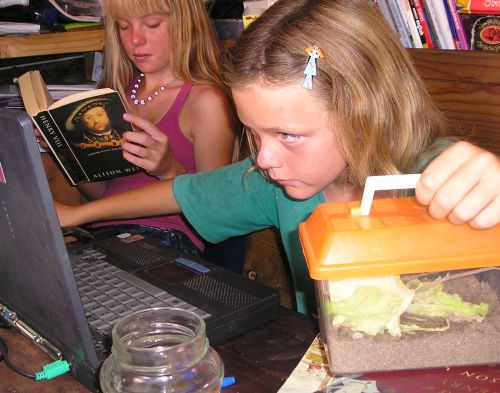 Nick’s parents managed to sail round the world when in their early sixties – but they had Nick to help them. If you doubt whether your own youngsters will want to skipper your boat for you, or if you simply don’t want to wait so long, then my advice is to GO NOW! If the only thing holding you back is the concern for your kids’ education the following words may be of comfort. DIY education is a subject which is very dear to us at the moment because the kids have finally had the opportunity to put theirs to the test, and to see whether homeschooling is as effective as the conventional kind.
The word home-schooling sits uncomfortably with us. Schooling implies formal lessons; it implies rows of children sitting quietly at their desks while an adult pours forth words of wisdom. Schooling also implies discipline and control – which is why a lack of discipline on the part of the students and loss of control on the part of the teacher signal a breakdown in the traditional system of education. For me, and I suspect for many other people, schooling conjures up feelings of despair. I loathed and detested school; it was a prison for both my mind and body. So far as I am concerned, the only truly likeable school is a school of porpoises.
Except for a couple of fortnight-long taster sessions, Caesar and Xoë have never been to school. Nor have they often been required to sit down and do lessons. We continue to use the term home-schooling simply because this is a concept that other people can readily understand. Ever since man first thought of providing formal education for his offspring children have been “home-schooled” by tutors and governors of one kind or another, and thus no one has any trouble picturing a child doing lessons at home with Mum standing in for the teacher. What people do have trouble understanding and accepting is the School of Life approach. Indeed, we have yet to meet anybody who hasn’t looked at us askance when I say, “We don’t generally do lessons. The children just teach themselves.”
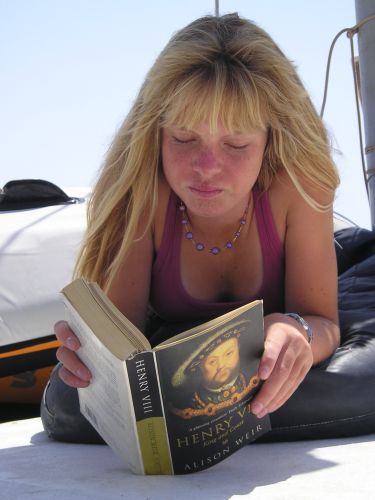 When I first realised that I was going to have to home-school my son I was daunted – but I was also excited. Even before Caesar had made his formal entrance into this world I was hunting out advice and investigating the business. It was important to me to have all our paper work in order, although we don’t particularly like it, it is much more important to ensure to avoid legal drama with the children. In that same vein of thought we also made certain to get ourselves and the kids proper visa documentation for travelling to the various places we might end up. We found a lot of help from www.omanevisa.co.uk, situations can vary quite a bit and I really do suggest to triple check your documents and have all your ducks in a row before setting sail. Like most people, I believed that it was illegal to keep a child away from school; I also thought that a teacher had to have a degree in education. Since we were not going to be living in the UK this was of little consequence – drifting about from one country to another on the ocean waves we were not subject either to British law or to any other set of laws – but, as it happens, I soon discovered that even if you live in England you do not, in fact, have to send your child to school. And if you want to keep him at home you do not have to provide a qualified tutor. Under English law it is the responsibility of the parents to ensure that their child receives “efficient full-time education … at school or otherwise”, and the whys, wheres and hows of the “otherwise” are not defined.
My next preconception concerned the National Curriculum. I began my quest determined to stick strictly to the Curriculum, imagining that to deviate from this Chosen Way would cause all sorts of future problems for my infant, denying him opportunities and burning his bridges. This turned out to be utter rot. The National Curriculum is merely a set of guidelines intended to standardise teaching in state schools. It is not the bible of English education – and if it is, there remains the option of choosing a different creed. Deviating from the Curriculum will certainly not prevent your child from taking GCSEs or from attaining good results in these exams.
Bang went the first series of myths. The second set concerned the need for a course. After I’d read around, and discovered that hundreds of other mums and dads were managing to teach their kids without the aid of a formal syllabus, I realised that I could very easily do likewise. After all, did you learn anything at primary school that the average educated adult wouldn’t know, or that cannot be found in a kid’s reference book? Under-tens who are packed off to school learn about wildlife and history; they read moral tales and paint pictures; they go on visits to museums and to Areas of Outstanding Natural Beauty. In other words, they learn about the world that is all around them. Do you really need a curriculum to teach a child about the life we live and the world we inhabit? Do you really need to sit him down and give formal lessons about friction, and bio-diversity, and race relations when these things are all around us? I think not.
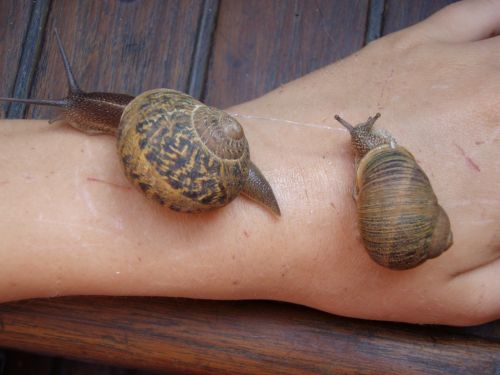 Being, by nature, inquisitive and eager to learn children garner information from all manner of sources. They harvest the pictures and words that they find in books; they scrutinise everything from the tiniest insect to the tallest thunder cloud, soaking up what they see. Above all, they learn about life by interrogating any adults within earshot. A set course or curriculum merely restricts the child, by seeking to keep his mind following a trail laid out by someone else. He will learn far more, far more happily if instead of a course he has access to a wide variety of stimuli, a plentiful supply of books of all kinds, and an adult companion who is able to answer his every question… or able and willing to hunt out the answers to questions which leave her stumped. Clearly, it helps if the adult is of an equally inquisitive nature and enjoys discovering the answer to questions like “How do snails make babies?”
Observation of other kids who were being home-schooled aboard other yachts merely reinforced my resolve to do without a course of set lessons. Curiously enough, for a bunch of liberal-minded drop-outs cruising yotties are surprisingly conservative when it comes to their children’s education. Nearly all of the families we have encountered whilst cruising use off-the-peg courses. Almost without exception the French follow their country’s baccalaureat syllabus – which just happens to be both compulsory and freely available… to them. English and American families tend to use an American course run by a company called Calvert.
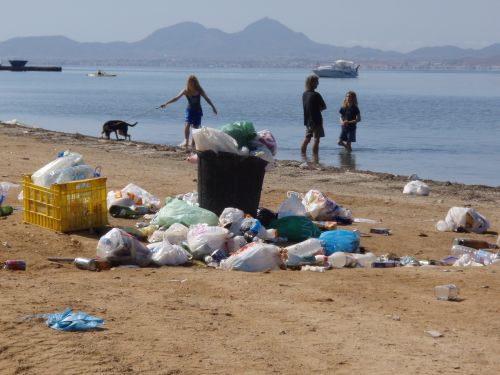 A quick glance at the Calvert School materials was all that was needed to put me off. Take, for example, their description of the wonders awaiting nine to ten year old students: “The fourth grade Calvert experience is a unique and thrilling one as your child will use the writing process to compose original compositions.” Oh, wow! If they haven’t been writing their own stories and essays since the age when they could first shape letters, what have the junior-aged Calvert kids been doing, one wonders? Copying texts? Nothing could be better guaranteed to put a child off writing than copying down someone else’s words. The fact that the course reading materials bear names such as “Mighty Men” and “A child’s study of famous Americans” is only to be expected, but one is startled to find a “Phonics Guide” amongst the literature. If your child cannot fluently read by this age then it is likely that the natural process has been disrupted – and an emphasis on phonics is, in my opinion, the most likely cause of his difficulties.
Regardless of what one thinks of the materials on offer, feeding your kids a set course has one inevitable result: whether they are anchored off Cape Town or Cadiz they will be learning about somewhere and something else; they will be filling their heads with facts about the American civil war or the science of light refraction, and missing out on the chance to study the local scene. My kids know very little about American history – and that’s because they have never been to America. While we were in South Africa they learnt about apartheid, the Xhosa, and South African flora and fauna; while we have been based in Spain they have learnt about such things as the reconquista, the process of desertification, wind-power, and the Spanish civil war. Surely, education should consist in more than just cramming the child with facts which will get him through exams? To be worthwhile schooling must be relevant to a person’s life.
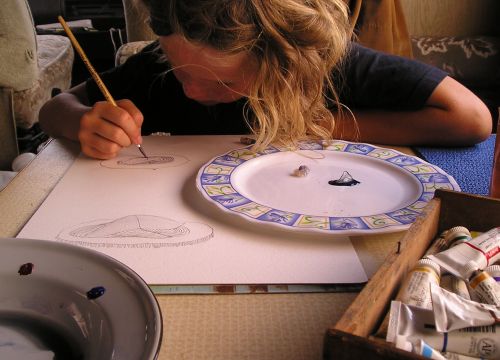 As I said at the outset, my children have seldom been given formal, sit-down lessons. It is true that they do receive maths lessons – albeit not so often as they should – and I have also been known to feed them chunks of history, biology, and geography. Every now and then I am smitten by the fear of failing to do my duty, and on these occasions the kids have to endure “projects”. “Right now”, I say, determinedly, as I snatch Coleridge from Xoë, haul Caesar off the computer, and grab Roxanne while she makes a dive for the door. “Today we’re going to do a project about Charles Darwin. Here are the books. Get going on it! I want an essay from each of you by supper time.” When they were smaller I used to do a lot of preparatory work before setting the kids such a task; I made sure that I already knew all of the answers. Nowadays I don’t bother; I let my students educate me.In the old days the children endured quite a few of these projects and produced attractive, well-illustrated, hand-bound booklets on such things as The Classification of Animal Life, The Discovery of the New World, Our Holiday in Etosha National Park, and Keeping Rabbits. Some of these projects went down fairly well but others did not, and eventually I realised that, to be effective, education should be relevant and requested. People simply don’t learn what they aren’t interested in learning, and if you try to make them write about things which bore them, they are apt to become even less enthusiastic.
Above all I learnt that sit-down lessons are the very worst way of installing knowledge into an unfertile mind. Learning is more apt to take root if it is handed out subtly, and acquired “on the go”. The children’s knowledge of Spain is a good case in point. Although I was unable to resist giving them a long lecture on the ancient history of the Mediterranean region (beginning with the Mesopotamians… and ending with the Visigoths) most of what the kids know about Spain they learnt in the course of our daily adventures. Spain is littered with castles and, inevitably, the kids wanted to know what they were for. I also wanted to know – indeed, I was very much more interested than any of the children in these romantic ruins. I could have genned up on Spanish history and kept the info to myself, but in this family knowledge is invariably pooled. If Roxanne comes across an exciting species of earwig, she brings it home and shows it to us; if Xoë finds a particularly beautiful piece of poetry she recites it at us; if Caesar learns something new about hypertext mark-up language, he tells us all about it… and so you may be certain that if I discover that a particular castle was built in such and such a year, and besieged and ransacked by so and so, I make jolly sure that everybody else is kept informed. (This urge to pass our learning to others is a strange one; it appears to be a universal instinct and probably accounts, in no small measure, for the success of our species.)
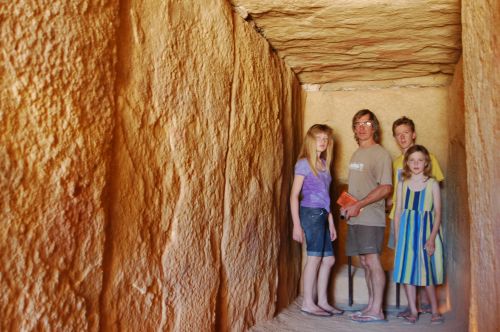 As it happens, neither Xoë nor Caesar is very interested in earwigs, and most of us feel that we could live very happily without being given large and frequent helpings of Shakespeare. Likewise, Caesar is the only one who knows what he is talking about when it comes to computing skills. When I open my mouth and say, “Do you guys realise that this castle was once the scene of an amazing battle?” the kids all groan. Yes, we all groan, each in turn, according to who is providing the sermon and on what subject – but, nevertheless, we all learn.
Sometimes the information falls on stony ground and withers away, but when the soil is appropriate wonderful things happen. While I rattle on about El Cid, Caesar will be busy studying the construction of the castle walls, or examining the installation of the flood lights. He isn’t learning much about the hero of the reconquista – but he is learning something. Meanwhile, Roxanne is chasing a beetle, and Xoë is mocking me – and lapping up every word. Xoë cannot abide being taught, and until recently she claimed to hate history, but the fact is that she adores it. In her the seeds tossed out by the Wise One have taken root and are flourishing. Not only has she pinched my Spanish History book; she is now demanding that we invest in a whole pile of others.
“This is all well and good,” says the nervous would-be home-schooler, “But what happens next? You’ve persuaded yourself that lessons are unnecessary; your kids have grown up unfettered, and you haven’t had to devote hours each day to schooling them – but now what? What happens when these un-schooled kids want to get a job or go to college?”
 People have been asking us this question for many years now – for 16 years, in fact – and I have often asked it myself… very quietly, after the kids have gone to bed. Does the School of Life system stand up to scrutiny? Last Christmas we decided that it was time to put the matter to the test.Caesar was approaching his 16th birthday and Xoë had just turned 14, and so we decided that the time was ripe for them to take some GCSEs. Having researched the matter we invested in five courses for each child – or, to be more accurate, their grandparents invested, forking out somewhere in the region of £2,500 for ten GCSE courses. The kids then invested vast amounts of time, Xoë with tremendous enthusiasm and Caesar only with regular goading from Yours Truly. The fact of the matter was that we had set the children quite a challenge. Since the GCSE exams take place between mid-May and June they had less than five months in which to devour and digest material which would normally be fed to the student over a period of two years.
On May 1st we all piled into our camper van and hurried north to the land of the big grey cloud. Lavant House School had very kindly agreed to let the children join in and sit the exams with their girls – an arrangement which suited Caesar admirably. As Xoë remarked , “They never ask me what I thought of the exam, but they’re always keen to chat up the only boy in the building!” On every occasion, in answer to the girls’ enquiries, Caesar would reply that the exam was a walk-over – on every occasion, that is, except one. When asked what he thought of the Biology exam Caesar merely shuffled his feet and muttered something about it not being too bad.
With the exams completed we meandered slowly back to the boat. Then followed two months of agonised waiting – or at any rate, Xoë affected to be in agony; Caesar played things very cool. The day finally dawned when the results were available, and with baited breath we listened as Daddy read them out. Caesar was shown to have been justifiably doubtful about the Biology exam – for Biology he scored a B – but in his other four exams he achieved top marks. Meanwhile, old Worry-Guts scored As in everything – as predicted (by herself). She even scored an A-star for English Language, and she and her brother both scored A-star for Spanish; as, indeed, they jolly well ought to have done after living here for two years!
Now the talk is of A-levels, and Xoë can hardly wait to get her hands on the syllabuses for her chosen five subjects. Where will we be in a year’s time, she demands to know? We haven’t the least idea; perhaps we’ll be back in St Helena or in Buenos Aires. Wherever we happen to be, our only fear is whether there will be somewhere for the children to sit the exams, because certainly we no longer have any worries about the standard of their education. Informal, totally relaxed home-schooling works; the kids have proved it.
If you have any questions that you would like to ask us about home-schooling, please use the comments form, below, or contact us.
I am an American from KY married to a Venezuelan living in the Seychelles Islands. We have 4 children, Marco-8, Paulo-6, Daniel-4 and Anais-2. We have been in the Seychelles for 9 years now and own a 41 foot steel sailboat. The plan is to start cruising sometime at the end of next year. My biggest worry is not the technicalities of cruising and traveling, but how to deal with 4 kids in such a small space and how to homeschool that many at one time. I’m in the very early stages of researching available resources so basically what I would like to know is what resources did you find to be the most useful in creating a cirriculum for your kids? There is just such a derth of information out there on homeschooling I don’t really know where to start. Any guidance you could offer would be much appreciated.
Thanks, Amy
Hullo Amy
It sounds as if you already have a pretty idyllic lifestyle, hanging out in the Seychelles – but perhaps it’s not all sunshine and sand and peacock blue water. Is there a down side to life on a tropical island?
A 41 steel ketch sounds just perfect for blue water cruising, but you’re right – it is going to be a little bit crowded with four kids to accommodate. Fun, though. And they are all quite young so won’t mind being crowded together. How you cope will depend very much on how good you all are at getting on together. If you already spend all day together there won’t be much change.
I would recommend moving aboard some months before you set off. Likewise, if the kids are in school you might want to consider taking them out a few months before you go (although this is far less important than the former). The more gently you break yourselves in, the happier you will all be. The very worst thing you could do would be to get everybody aboard just a couple of days in advance and then head off across the wide blue.
No doubt you already do plenty of day-sailing. Night sailing is very different, so far as small children are concerned. And after a couple of days at sea they start to ask, “We will go back to the land again one day, won’t we?”
As for schooling – I would suggest that you relax and take a very flexible approach. I can’t give you any advice about creating a curriculum, because we’ve never had one. And this despite the fact that, like you, I had great plans.
My son was hardly born before I was worrying about his education. He was hardly toddling before I was buying piles of reference books on every subject – everything from Maths through to Biology and Religious Studies! Most of those books have never been opened.
When he was 2 years old I was all set to buy a full course of books dedicated to teaching a child to read. But then I took a look inside one or two of them, and they were terrible; so boring and irrelevant! I thought, “I can do better than this.”
Briefly – to teach a child to read, you read to him.
To teach a child to write, you give him a pencil.
To teach a child to count, you count things with him.
There’s a little bit more to it than that – but not very much more! When you start doing it you will find that it comes as naturally as teaching the child not to throw his food around. And it’s a lot easier than teaching him how to tie his shoe laces. (I still haven’t managed to teach my 10 year old to tie her shoelaces efficiently…)
I would recommend that you read John Holt’s “Learning All the Time”.
To say that this book inspired me would be a gross understatement. It changed my life – and it changed the way I brought up my children. Basically, the message is that you don’t have to teach kids. They do it themselves, all the time.
I don’t see that you would have any problem teaching kids of such diverse ages. Just “teach” whoever asks the questions, and the others will listen in and join in.
Just choose a topic, and then get them all to do what they can, according to their abilities. You will probably find that they research and write as a team, helping each other.
Unless your children are naturally enthusiastic about keeping log books and making up their own projects you will have to get them to sit down, from time to time, and do some work. At this young age it really doesn’t matter what they study. They might be writing about turtles or dinosaurs or volcanoes or Muslims. Whatever it is, they won’t remember it – but it will affect them, on a deeper level, and they will learn how to read, write, research, organise their thoughts, use grammar correctly.. and so on. You can easily twist a project – any project – to include whatever life skills you want the children to acquire (eg. computing, drawing, making bar charts, dealing with percentages, etc). Try to choose projects which are relevant to where you are and what you are doing.
My two older kids still talk with enthusiasm of the Sealife Project that we did, over a period of months, when they were aged about seven and nine.
Another high point was the time when Xoë taught a school teacher the history of his island homeland. We’d just done a project on the history of the island, so that this eight year old upstart knew more about the place than most of the inhabitants!
We chose this flexible method not because it is easy (which it is) but because we had watched other cruising folk using the formal, set lessons approach. For the parents it was a terrible bind, but – worse than that – it also seemed to us that it made the kids hate learning.
Learning is a natural process; whatever our age, we are always keen to learn – unless forced education has crippled us.
If, having heard all of this, you still want to do it the hard way, you should take a look at the Calvert materials.
You can also find out about them by searching on Wikipedia for Calvert School.
This page is little short of being an advert, and when you read it you will probably find that the avowed principles appeal very strongly : –
“The essence of a Calvert education is a solid grounding in reading, writing, and arithmetic. The reading program uses materials of superior literary quality and stresses comprehension and analysis. Students learn to write with style and discipline under close supervision. The principles of English grammar reinforce proper written and oral expression. Basic mathematical skills are mastered so that they become useful tools in solving quantitative problems. Calvert emphasizes creative thinking and problem-solving. Integral to the Calvert program is instruction in methods of organizing work, studying for tests, and preparing and presenting research papers. Teachers help children understand and learn from their mistakes. By requiring students to correct their work, teachers encourage accountability, pride in work, and a sense of accomplishment.”
There is absolutely nothing in that paragraph that I could criticise. And if I believed that a course of Calvert lessons would achieve all this I would enlist my kids straight away. However, my natural suspicion of hype combined with my casual observation of people who are using this system causes me to suspect that there is a wide gulf between the fantasy and the reality. It seems to me that the Calvert system (and the New Zealand state home-school system, and other, similar distance learning systems) probably achieve better results than the schools – but not such good results as flexible, child-led home-schooling.
One of my strongest recollections, having glanced over the Calvert materials, aboard a friends’ boat, was the fact that the kids were studying the American Civil War. There was absolutely nothing wrong with that – except that they were hanging out in Antigua at the time. They knew absolutely nothing whatsoever about slavery or the sugar industry, or about calypso music. They didn’t even know about the local flora and fauna. There wasn’t time for them to learn any of that, because they spent almost the entire day studying, to keep up to standard.
What is the point in taking your kids off to see the world, and then not giving them the chance to really get to see it?
My older two children are now 15 and 17, and they are studying for their A levels. These are important exams in England, and if they want to be able to go to university the kids must have them – but they, and we, bitterly resent the time wasted; time when they could be studying things which are of interest and importance to them.
I am so very glad that we didn’t force-feed them school lessons, and waste their time, when they were younger.
But there I go again…!
Let me know how you get on!
All the best
Jill
Hi Jill,
Thanks so much for getting back to me. I have ordered your book as well as Learning All The Time from Amazon.
One American trait I can’t get rid of is worrying that the kids might miss out on something if I don’t follow some form of curriculum, at least to start. We are leaning toward the Calvert school just for the first year, and after that we can see how it goes with a bit more experience. One wonderful thing of the modern age is Ebay, so we have found the whole years worth of materials used for approx. $300 vs. the $750 new price tag. We will probably use Calvert as a basis and not follow it religiously, especially the American history. We are very learning oriented people so I know I will not have a problem getting out there and creating learning opportunities in Southeast Asia. I would rather teach about world religions and cultures than the American Civil War. Another resource I came across that you may not know about is eTap which has the whole curriculum from K-12 online for $400 and you can use it for multiple children. It looked pretty good but I’m a bit worried about internet access. They say you can print materials if you don’t have access, so this may be an option. I really appreciated the advice of moving aboard before hand so we can adjust gradually. I hadn’t really thought about that. We are going to begin cruising here in Seychelles. It would be crazy to leave here without seeing Aldabra!!!! It is quite a distance away from Mahe, about 1000 miles I think.
There is a small downside to living on a tropical island. It is very small!!!!! Our typical weekend starts like this. “So what do you want to do this weekend. Should we go to the beach or go to the beach.” We do love the beach, but it would be great to have somewhere new to explore and hike, and museums and cultural activities to explore.
Thanks again for the help.
Sincerely, Amy
I would like to thank you for your article. My husband and I have anguished quite a bit over the education of our 12 year old boy/girl twins as we embark on our dream of cruising. New to cruising and living aboard our 42″ catamaran has been a life changing experience with so many new challenges that the worry over their education and what we would do about it has been a dark cloud lingering with uncertainty.
Although, much remains to consider I wanted to thank you for sharing your experience and encouragement.
Delena
I love your web site and its beautiful educational reports, photographs and quizzes. I have been looking for a good text on identifying sea birds. Do you have any you could recommend? Or is that your next publication?!
We are only just getting started. We bought one of the 72 foot steel Global Challenge yachts and brought her from England to Mexico on a delivery/shakedown cruise. She is currently out of the water having pre-emptive strikes against her rust, modifications to her plumbing and a bow-thruster fitted. We plan to throw off the bow-lines in the new year. We have four children, 15, 13, 10, and 5. We have always homeschooled, partly because we enjoy it and having our kids around, but also in preparation for our long-planned-for transition to cruising. Our educational philosophy has always been what yours is and I commend and congratulate you on your wonderfully accomplished children.
I hope our paths might cross one day, but until then, your research will be an inspiration to us and I look forward to reading your future entries.
Best Wishes
Clare Collins
Hullo Clare
Many thanks for your kind comments and encouragement.
Wow – that’s a BIG boat you’ve bought! But with all those kids you will have plenty of crew – and lots of fun. Yes, it would be great to meet up with you someday, in some distant corner of the globe. Have you decided where you are heading?
I’ve just dipped into your website (VERY briefly) and I saw that you have been boating on the Llangollen canal. My uncle used to live just around the corner from there – he was the vicar of Chirk – and so I have many happy childhood memories of the area and of the canal tunnel.
I think it will be a little while before we are writing books on seabirds…! Although Roxanne and Caesar are actually putting her Seagull Survey into book form.
So far as I am aware, the best seabird ID guide is Harrison’s (Seabirds – An identification guide by Peter Harrison). It isn’t totally up to date – for example,you won’t find yellow-legged gull because until four or five years ago it was considered to be a sub-species of the herring gull – but it’s the best, by far, that I’ve ever come across.
All the best
Jill
Your book, “Kids in the Cockpit” just arrived from Amazon yesterday, so it was wonderful to read your reply today. I am glad you go so thoroughly into testing life jackets in your book. I was so horrified years ago to see a baby life jacket turn and hold my baby face down in the swimming pool that I have never trusted them since!
How fun that you have the Welsh connection. How romantic to be the Vicar of Chirk! That was an utterly delightful vacation and I nearly had us convinced to buy a Dutch barge to travel Europe’s canals and rivers, but we decided we didn’t want to be hemmed in.
Dear Jill,
I am at the moment researching home schooling for my 13yr old son as we are planning to go cruising this year. After reading your article I wish we had gone sooner as I believe your idea of ‘learning where you are and as you go ‘ sounds brilliant and it obviously worked for your kids.
But, my son has been in the state school system all his life and as we are only cruising for a year or two which happens to be the two years he should be studying for his GCSE’s we will have to enrol in a home schooling site. You say that your children took their GCSE’s and passed with flying colours (brilliant) but you don’t mention where you acquired the materials for them to study.
I have come across Oxford Homeschooling and according to their website they ‘seem’ to be very good but as time is crucial for us we can’t afford to have the same experience with this company as you did with Mercer. Therefore, I wondered if you could let me know which home schooling you used for your childrens GCSE’s was it NEC College? Have you heard of Oxford Homeschooling or know anyone that has used it?
We are pretty confident that our local school will allow our son to sit his exams with them. With this in mind we have to make sure that he is being schooled with the same examination board as the school which is AQA.
I wish Xoe and Caesar luck in their A levels.
I have thoroughly enjoyed reading your website and look forward to future instalments.
Best wishes
Philippa
Hullo Philippa,
Thanks for your comments and questions. I am glad to hear that your son’s educational needs have not put you off going cruising. I believe that he will gain as much from this adventure as from a whole childhood of schooling.
No, we haven’t used Oxford Homeschooling and don’t know anyone who has – but don’t let that put you off. They are one of the organisations which we considered, and it seems from their website that they have a good track record. I would imagine that if you contact them and ask for testimonials and references they could put you in touch with former students.
We used the NEC for the children’s GCSEs and, as a result of our problems with Mercer’s College, we are now also using them for Xoë’s Classics A Level. I believe that they follow the AQA syllabuses for most of their GCSE courses.
You will need to be sure that the courses which you choose for your son do not contain requirements which are difficult for a home-educator to meet. I am referring here to the “coursework” element. Coursework, in this context, means work which is done during the course but which counts towards the exam.
Until recently coursework could be approved by the Distance Learning (DL) organisation, but now, it seems, it has to be done under examination conditions and certified, by a tutor or an invigilator, as the work of the student concerned. This is a ridiculous requirement, because the question is handed out days in advance, and the children are taught how to answer it!
I suggest that you discuss this subject with your chosen DL provider, before you dive in. There are ways of getting around the problem. For example, if your son’s former school is co-operative they may be willing to let him do any required coursework at the school a few days prior to the exam. Even so, I would avoid this element if you possibly can. In our experience, coursework questions are very vague and leave the student (and the parents) completely bemused.
For more information on this subject you should make a list of the exams which your son wants to take, find out which exam board each DL provider uses for each of these subjects, and then visit the relevant exam board websites. Each exam board provides, on its site, full details of each exam. Your task is to identify the appropriate exam specification (being careful to ensure that it is the one intended for the year your son will be sitting the exam) and wade through the verbose descriptions, hunting for the dreaded words, coursework requirement.
If you can manage all this for each of five or ten subjects without throwing a fit or needing a large stiff drink, then you deserve a medal.
Incidentally, although you are “pretty confident” that your son’s old school will let him sit the exams there, I recommend that you ask in advance, just to be absolutely certain. I make this suggestion simply because I know that many home educators have a lot of problem finding a school which will accommodate “outsiders”. It is a constant topic of conversation on home education forums.Private schools are generally more enthusiastic than state schools. Some – such as the one which we stumbled upon – are even willing to invigilate exams which their own students are not sitting, hosted by boards which they do not, themselves, regularly use.
Clearly, it is worth finding out about this sort of thing before you select a course and a DL provider.
I hope you find this information useful.
Wishing you fair winds (and not too strong) for the trip south. If you will be stopping in the Canaries give us a shout. Since flights to the UK are cheaper from here than from the Cape Verdes, or anywhere else on our itinerary, we will probably be hanging out in this vicinity until after the children have taken their A levels.
Jill
When did you find snails like that?
Sorry I ask weird questions all the time. Sometimes they’re not weird, it’s just the voice I speak in.
I found the snails under some stones, on a patch of waste ground, in Spain. They mated and laid eggs in a hole in the earth (in a vivarium that I had), and I looked after their babies for a few months.
Roxanne
Hi Guys,
I have just been reading about home schooling & I so need to meet you guys again one day!
I would have been worried too about if I could cope with home teaching, but your worries have been blown away eh!
Incredible kids, well incredible family!
Makes me feel a bit of a dullard!
Good on you!
Bear
Hi Guys
Love the redesigned website! We are a family of 4 (mum, dad, Bethany aged 11 and Bryn aged 10) who are now in our 3rd year of cruising and homeschooling. We started off with UK curriculum-based materials (CGP workbooks) but now have a much more relaxed attitude to how Beth and Bryn learn, and a much better understanding of where their strengths and weaknesses lie. We now do projects on whatever the children are interested in, we learn (together as a family) about the history, geography, culture, religion, and customs of wherever we are, and we try to involve the children in helping us deal with the practical problems of boat life. While people are often fascinated to hear about our life, one of the first questions we get asked is what will we do about the children sitting exams. I often come back and re-read your articles on homeschooling — it reminds me that we are not alone and not totally weird! We are currently wintering in Greece and the children are going to school for a couple of months — their first taste of it for 3 years. They take in our boat school project materials to work on when they can’t join in and the whole episode is just to make friends and learn a bit of Greek. They are enjoying the experience, but we are all looking forward to getting back to ‘normal’ boat school — where we all learn a lot more! I hope that we get to meet you guys somewhere, someday. I was interested to see the link with Clare Collins, Llangollen and Chirk — I was brought up in Llangollen and lived in sight of the canal.
Sarah
Hullo Sarah
It’s always great to hear from people who are “schooling” their children in the same informal way; and, as you have already discovered, it’s an effective way and it’s fun for the whole family.
I think the idea of sending your kids to school, for short periods, in a foreign country is a very good one. We never really did this – largely because the kids didn’t want to – but I’ve noticed that cruising kids who spend time in schools in other counties always seem to end up being fluent in other languages. For example, we know a young French man who grew up cruising. He is completely fluent in English, having spent some time in schools in South Africa and England, and he also speaks Spanish and Portuguese.
Jill
Hi Jill,
I have just ordered your book and my husband has read your site inside and out. We have just moved onto our 48ft catamaran in the whitsundays Australia with our 5 and 3 year old. Though I still fight the deep seated program of formal education ( with well meaning family reminding me) your approach is what seems to feel right and we will continue with that.
As it will take a month or so for your book to arrive I was wondering if you could clarify why you feel phonics is not a good teaching method.
Also any imedidiate activitie ideas to keep a 3 year old girl and 5 year old boy occupied would be good.
Thanks for all your experiences on the site. A highly valuable tool for beginners to the experienced I’m sure.
Happy safe sailing to you and the family.
Thankyou
Lou
Hullo Lou,
A number of peple have written to me on the subject of learning to read. I am intending to write short article on the subject – but, in the meantime, here are some thoughts which seek to answer your question:
Phonics can work for some kids but it certainly doesn’t work for all. In my experience (based on teaching my own children and watching other people’s ) I should say that phonics works only with people who have logical, tidy minds. The sort of person who can get to grips with maths at an early age may well learn to read by using some form of phonics.
The trouble with phonics is that it isn’t as logical as we would like to imagine. Merely teaching the child to pronounce A as in bat, and B as “Buh”, and C as “Cuh” doesn’t work – not in English anyway. In some languages the pronounciation of words and letters is very orderly, but the English language is a wonderful mish-mash of lingos, all stirred around and served up with complete disregard for any rules.
Phonetics is really only appropriate when it deals not with individual letters but with chunks. People learning to read memorise those chunks. eg. Mem-or-rise
This is the way in which my (very logical-minded) son learnt to read. I know this, not because I made him do it that way but because, like most small kids he began by reading out loud. I was able to hear him sounding out the words, bite by bite.
My elder daughter, who is very clever but who has a very “anti-logical” way of thinking learnt to read by simply recognising the words. Every word was photographed by her amazing mind, filed, and never forgotten!
The crucial thing, as with all teaching, is to be led by the child. Let him do it his way.
And relax – cos it’s really very, very easy!
Jill
UPDATE: The article on learning to read is now on line
Hi Jill,
I, too, have a 3 and 5 year old, and we are setting sail this Fall on a 44′ Cat. I am a certified teacher with a master’s degree, so am very excited to get to plan their education. My question is… how do you determine which books to bring aboard. I LOVE to read, and am going to have such a hard time deciding between books, especially reference books that can be so valuable in real-life learning situations! Any suggestions based on your experiences?
So glad to find your site, filled with encouraging education information!
Sarah
very nice
We are a family of 4, currently homeschooling on land in America. We are looking to move to a less anchored lifestyle, and I am greatly encouraged by your family’s stories – particularly, your children and how well they seem to have adapted to the Holt style of learning. Our children’s education is one of our greatest concerns, but your views jive well with my own insights into learning – and I’m excited to set sail into the School of Life 🙂
Wishing you calm seas,
Dana